Data
We Crunched 11,022 Public-Piano Pins—and New York Lost All Three Times
Three absurdly specific density tests crown Troy, the City of London, and Boston while revealing what a public-piano map can—and cannot—tell us.
New York has 358 mapped piano records, more than any other city in the archive. It also fails to win any of the three density contests below.
That is not a contradiction. “Most pianos” and “most piano-dense” are different questions—and density gets delightfully strange when the objects being counted can be rolled onto a sidewalk for one summer, moved into a station, photographed for a decade, and then vanish.
So we tested three versions of the question: Which places pack their piano records into the smallest rectangle? Which have the most per resident? And where could you assemble the most ambitious one-kilometre piano crawl?
The winners are Troy, Ohio; the City of London; and Boston. Lancaster, Pennsylvania, is the terrifyingly consistent all-rounder. Here is how the keys fell.
First, a necessary data tune-up
We took a private snapshot of the site’s piano catalog on August 3, 2026. It contained 11,022 piano records, 31,943 underlying sightings, and locations across 156 country slugs. The oldest sighting was from April 2011.
The snapshot also contained a few unmistakable duplicate submissions from the same import batch. Mill Creek’s four named 2026 pianos, for example, appeared as eight records; Troy’s mapped 2026 set appeared twice too. We collapsed records when they were submitted on the same date, belonged to the same city, had matching or name-within-a-name titles, and sat within 500 metres of one another. That removed 116 duplicate records and left 10,906 records for analysis.
This cleanup changes the rankings but does not alter the live catalog, so a linked city page can show a slightly larger raw count. We then required at least five cleaned piano records for a city to qualify. That left 364 eligible city labels.
One more large-print footnote: these are pianos reported past or present. They were not necessarily outdoors at the same time, and a place’s rank is not a promise that any particular instrument is playable today. Check recent reports before making a pilgrimage.
Test 1: the smallest-box showdown
For every city, we drew the smallest north–south/east–west rectangle containing all its piano points. We measured its width at the rectangle’s middle latitude, multiplied width by height, and divided the city’s piano count by that area. This is not municipal land area. It is the footprint of the piano archive—and one far-flung pin can stretch it dramatically.
- Troy, Ohio — 7 pianos in 0.048 km²: 145.1 per km². The box is only about 221 by 218 metres.
- Klagenfurt, Austria — 7 in 0.111 km²: 62.9 per km². Its mapped points fit inside roughly 464 by 240 metres.
- Joliette, Quebec — 5 in 0.098 km²: 51.2 per km². Five records are enough when the rectangle is smaller than one-tenth of a square kilometre.
- Mount Gambier, Australia — 5 in 0.104 km²: 47.9 per km². Its narrow 226-metre width does a lot of work.
- Monaco — 5 in 0.161 km²: 31.1 per km². A compact city-state produces a compact piano box; no surprise there.
- Bonn, Germany — 12 in 0.388 km²: 31.0 per km². Monaco beats it by less than two-tenths of a piano per square kilometre.
- Arnhem, Netherlands — 7 in 0.256 km²: 27.3 per km². Several records point toward the station area, a recurring public-piano habitat.
- Walnut Creek, California — 8 in 0.320 km²: 25.0 per km². A seasonal painted-piano program keeps the pins close to downtown.
- Schiphol, Netherlands — 5 in 0.223 km²: 22.4 per km². An airport locality is an excellent reminder that “city” is whatever the geocoder put in the city field.
- Zwolle, Netherlands — 5 in 0.257 km²: 19.4 per km². Its rectangle is long and skinny: about 203 metres by 1.27 kilometres.
Troy’s victory is real, but the archive is not complete. The city’s official 2026 Painted Pianos Project page says eight upcycled instruments were placed downtown through August; the cleaned export represents seven. Even the winner is a reminder that a community map is a field notebook, not an omniscient piano census.
Test 2: pianos per resident
Next we screened the eligible place labels, removed counties, airports, historic districts, and other labels that were not comparable municipalities, then matched the plausible leaders to official census boundaries. We used 2020 census counts for the United States and Japan and the 2021 Census for England. The score is cleaned piano records per 100,000 residents.
This is deliberately an all-time archive divided by a one-time population count. Read it as “public-piano history relative to city size,” not “pianos simultaneously available per living human.”
- City of London, England — 12 pianos, about 8,600 residents: 139.5 per 100,000. That is roughly one archived piano for every 717 residents. The tiny residential population of the Square Mile is an extremely powerful denominator.
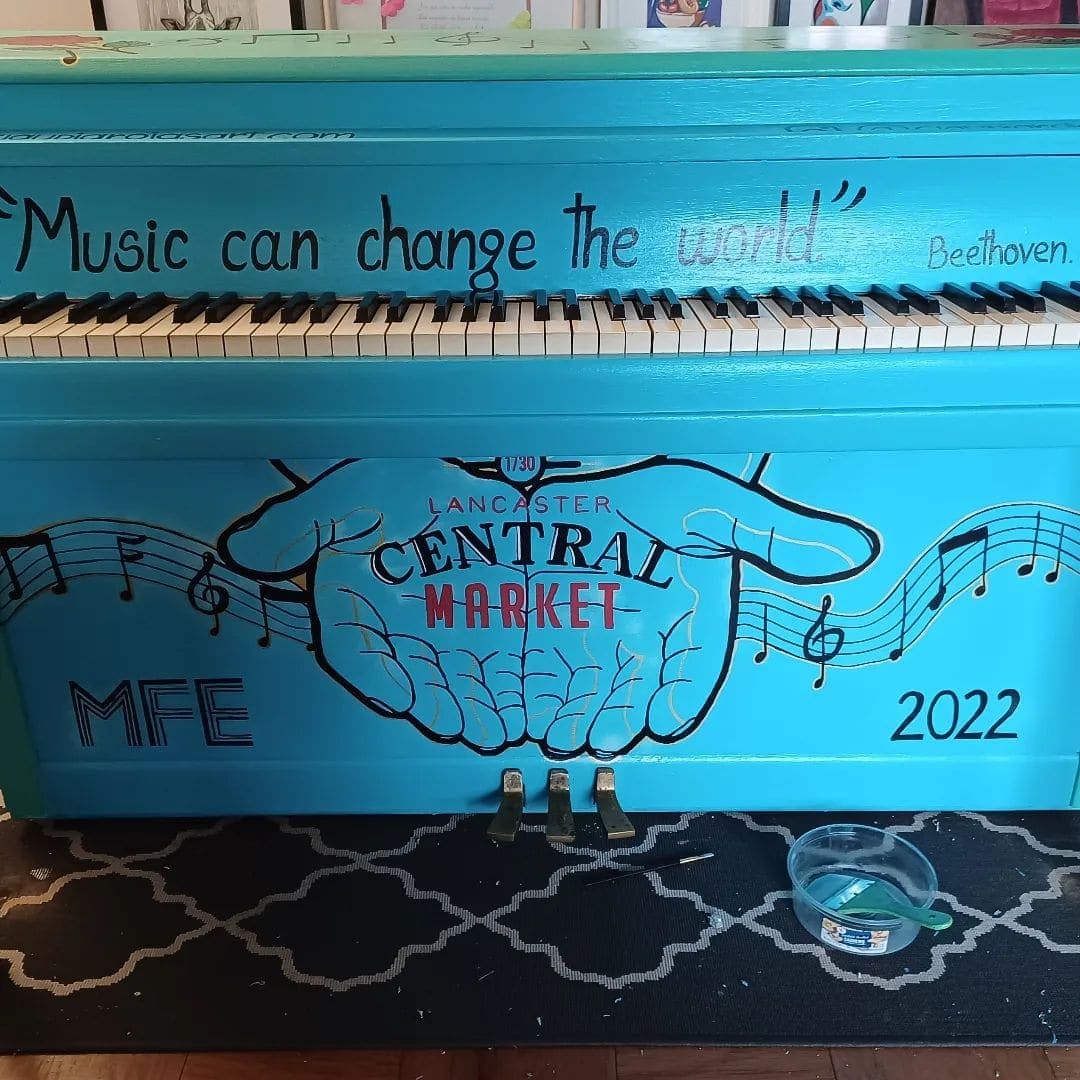
- Lancaster, Pennsylvania — 48 pianos, 58,039 residents: 82.7 per 100,000. The local Keys for the City program is comfortable calling Lancaster the “Street Piano Capital of the World”, and the numbers make that boast sound surprisingly restrained.
- Chiyoda, Japan — 29 pianos, 66,680 residents: 43.5 per 100,000. Tokyo’s central ward lands ahead of every ordinary large city in the ranking.
- Traverse City, Michigan — 5 pianos, 15,678 residents: 31.9 per 100,000. The five-record minimum is doing exactly what it was designed to do here: letting small, genuinely piano-rich cities compete.
- Miyazu, Japan — 5 pianos, 16,758 residents: 29.8 per 100,000. One piano record for roughly every 3,352 residents.
- Niagara Falls, New York — 13 pianos, 48,671 residents: 26.7 per 100,000. The falls are not the only local attraction capable of making a little noise.
- Troy, Ohio — 7 pianos, 26,305 residents: 26.6 per 100,000. It misses Niagara Falls by about one-tenth of a piano per 100,000 people.
- Atlanta, Georgia — 129 pianos, 498,715 residents: 25.9 per 100,000. This is the first roughly half-million-person city on the list.
- Fort Collins, Colorado — 43 pianos, 169,810 residents: 25.3 per 100,000. It also reappears in the piano-crawl ranking below.
- Boston, Massachusetts — 170 pianos, 675,647 residents: 25.2 per 100,000. Boston edges into tenth place—and then wins the next test outright.
The City of London result needs the loudest asterisk. Its resident population is tiny compared with the commuters and visitors who use the Square Mile, just as Schiphol’s resident count would be nonsensical for an airport piano. Per-capita rankings describe residents, not the audience actually passing the keys.
Test 3: the one-kilometre mega-crawl
A bounding box punishes one distant outlier. This final test ignores the outskirts and looks for each city’s densest pocket. We treated every cleaned piano point as a possible center, counted all the city’s points within a one-kilometre straight-line radius, and kept the largest count.
This is an imaginary crawl through the full historical archive. A one-kilometre radius is not a one-kilometre walking route, and these pianos did not all coexist. It is still a useful way to see where public-piano activity has repeatedly converged.
- Boston, Massachusetts — 61 pianos within a 1 km radius, from 170 citywide records.
- Melbourne, Australia — 51 within 1 km, from 109 citywide.
- Vancouver, British Columbia — 49 within 1 km, from 113 citywide.
- New York, New York — 44 within 1 km, from its chart-topping 358 citywide records.
- Lancaster, Pennsylvania — 44 within 1 km, from just 48 cleaned citywide records. New York takes the tie-break on total records; Lancaster wins on audacity.
- Augsburg, Germany — 39 within 1 km, from 49 citywide.
- Portland, Oregon — 31 within 1 km, from 122 citywide.
- Fort Collins, Colorado — 29 within 1 km, from 43 citywide.
- Bristol, England — 28 within 1 km, from 46 citywide.
- London, England — 27 within 1 km, from 240 citywide.
London wins the final listed slot on the total-record tie-break. Seattle and Leeds also reach 27 inside their best one-kilometre radius.
The revealing comparison is New York versus Lancaster. New York’s archive is more than seven times larger after cleanup, yet both cities peak at 44 records in the same radius. Lancaster has concentrated years of Keys for the City activity into a downtown that behaves like a piano festival even when viewed across time.
So where is the public-piano capital?
Choose your preferred form of statistical mischief:
- Troy wins the tiny-rectangle test.
- The City of London wins per resident, helped enormously by its unusual daytime-versus-resident population.
- Boston wins the densest historical one-kilometre pocket.
- Lancaster is the best all-round argument: second per capita, tied for fourth in the mega-crawl, and backed by a program that has been putting decorated instruments downtown for years.
- New York still wins the simple volume contest with 358 records and 2,153 sightings. It just has too much city around them to win a density crown.
These rankings will move as the map grows, old duplicates are reconciled, and new programs roll instruments onto new sidewalks. That is not a flaw so much as the point: public-piano geography is temporary, communal, and gloriously hard to keep still.